 HLM in Seine-St.Denis where my ASSFAM office is located
In thinking about the recent events, I've been struck by what I call the Banlieu Paradox. In the rough and tough banlieus exist two worlds; those who are ready to fight in contest of their miserable living conditions, others making huge sacrifices, sometimes risking their lives just to get in.
Banlieus are found on the outskirts of a great number of french cities. They usually contain a few nice communities but are mostly composed of cités. Cités are conglomerations of about 5-8 tall, austere concrete block buildings subdivided into as many apartments as will fit. My boss lady took me and the other intern on a car tour yesterday to check out the neighboring cités… we quickly realized our building (seen above) is quite nice compared to the others. We came across street after street of depressing, massive, institution-like complexes. The cités have extremely dense populations crammed in to a small space… huge amounts of human energy with no outlet for diffusion. In the banlieus, there are too few jobs, very few centers for activity… just a sad looking gymnasium here and there.
Banlieus are found on the outskirts of a great number of french cities. They usually contain a few nice communities but are mostly composed of cités. Cités are conglomerations of about 5-8 tall, austere concrete block buildings subdivided into as many apartments as will fit. My boss lady took me and the other intern on a car tour yesterday to check out the neighboring cités… we quickly realized our building (seen above) is quite nice compared to the others. We came across street after street of depressing, massive, institution-like complexes. The cités have extremely dense populations crammed in to a small space… huge amounts of human energy with no outlet for diffusion. In the banlieus, there are too few jobs, very few centers for activity… just a sad looking gymnasium here and there.
Take for example, a cité called "les 4,000". Imagine a street the length of a block, with large towers composed of 4,000 apartments, each housing an average of 3-4 people. Now imagine on your suburban street, those of you who get mad at the guy down the street for things like leaving trash out (or vice-versa), having 12,000 neighbors!
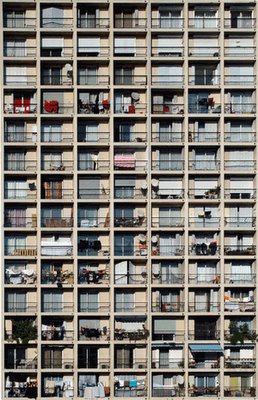
These buildings, called HLMs, are provided by the government. France, being a State of “solidarity” – meaning those who have more help those who have very little, construct HLMs in order provide cheap housing for those with small incomes. Unfortunately, they are often built cut-rate, too quickly, with little planning in terms of integrating them in to a viable community. No commerce, few parcs, etc. Poorly designed housing goes back before the 30s when large influxes of immigrant arrived in France. They were encouraged (or forced in the case of many Algeriens) by French officials to come and fill low-wage industrial jobs. These immigrants were always considered temporary employees and therefore the government never bothered to make available adequate lodging. But as years passed, families settled permanently. It is in large part the children and grandchildren of these earlier generations that today are out on the streets vindicating the miserable condition of their communities.
However, the government has put forth great efforts in the last 10 years to rehabilitate these areas. The most dilapidated of towers were demolished, replaced with smaller, more convivial complexes. Extra funds were given to schools in “priority zones” to incite more teachers to come to rough areas and also so schools would be just as equipped as those in richer communities. But, these efforts have done nothing to tackle one of the biggest problems, an extremely high rate of unemployment (40%). It most clearly shows the huge socio-economnic gap between the immigrant dense banlieus and the rest of French socity. And understandably, it leaves a great number of people frustrated and undervalued. That is why Prime Minister Villepin, when he was on the national news the other night, added in his pack of goodies (meant to calm rioters) tax breaks for companies agreeing to build and hire people in these struggling communties. It has been done in the past and with relatively good results.
Now, there is also a huge population of sans papiers, immigrants residing illegally in France. No one really knows how many there are. But, from my experience at work, where we have people knocking at our door every day asking us for help getting them legalized and from the huge sans papiers street protests, I gather there are a large number. They all tell us how horrible it is to have to live in the shadows, always fearing being forced back in to their country. As said before, many arrive because of extreme hardship in their homelands… civil wars, lack of medicine or food, etc. But MANY, come with the false illusion that France is paradise, the land of opportunity. A taxi driver from the Congo explained to me, “you see, they leave with these false ideas, they tell their loved ones they will go and get a good job, make a better life for themselves and their families. Then, they arrive and life is hard, very hard. But, they don’t want to admit it to their families. You see, it is less hard to stay and struggle than to shatter the image, the hope, their loved ones hold back home. Returning to their country would be seen as a defeat."
So for whaterver reason they come to France, often times leaving all their friends and family behind and then struggle for the most basic needs. It is extremely difficult to find shelter. It is not easy to get someone to agree to lodge them. Legal immigrants found housing sans papiers risk expulsion, French citizens risk heavy fines. And though there is a substantial amount of under-the-table jobs such as working in an illegal textile plant, selling vegetables at the market, working construction jobs, they are never stable in pay nor permanent. And since their precarious situation is known, they are easily exploitable. So you see, for the many sans papiers of the banlieus, having their own little space in one of these towers with cheap rent, the right to look for a real employment, the ability to benefit from the enormous financial aid packages the government doles out is the dream. Quick note; for those immigrants that we can help get legalized, they still must face the current 6-7 year waiting list for a spot in an HLM! There is a HUGE housing crisis in France.
You see, it is very difficult to hold a stance when there are so many sides to juggle… the government who has done tremendous work to try to rectify social ills but unable to meet the roots of the problems, the young kids acting out of rage and frustration for their alienation and discrimination and finally the poor individuals who have absolutely no voice and no rights, just struggling to survive.

